12 Sep 2026
Hair Loss in Women and Men: Causes, Types and the Treatments We Offer in Mayfair

Written by Dr Alexa Balan, GDC-registered dentist (GDC no. 293266)
Published
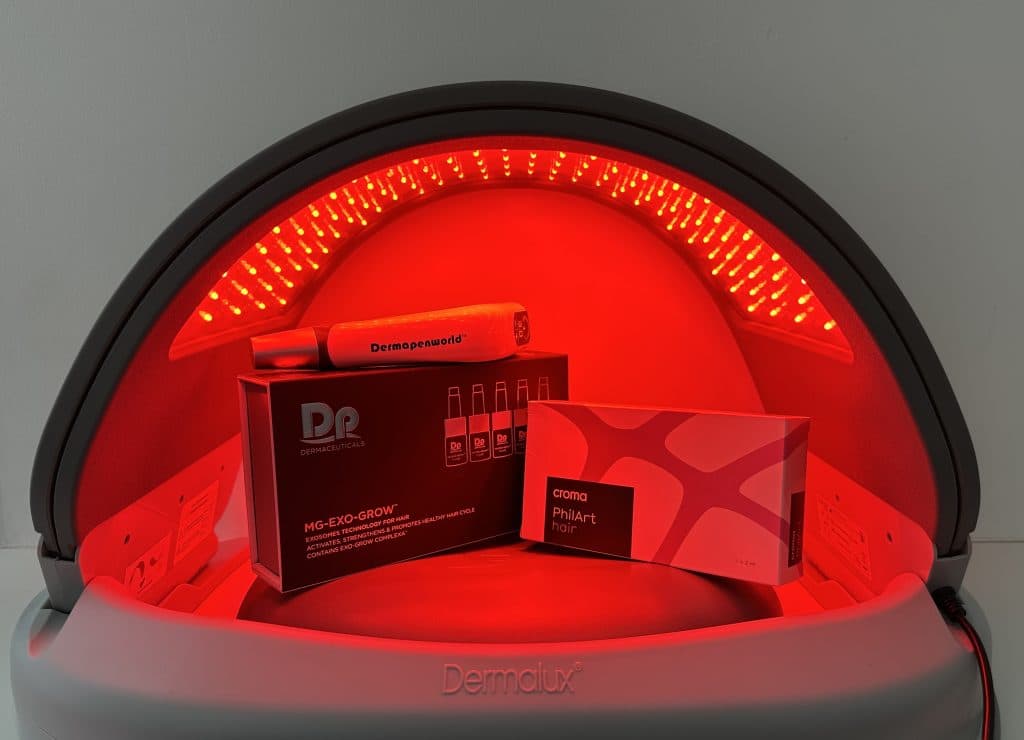
Thinning hair or shedding? The causes and types of hair loss in women and men, and how PRP, polynucleotides, microneedling and red light therapy can help.
Key takeaways
- Find the cause first. Different types of hair loss need different treatments.
- Act early. Treatments work best on thinning hair while the follicles are still active.
- Hair grows slowly. Expect to wait 3–6 months to see a real difference.
- Combination plans usually work best, for example PRP or polynucleotides alongside red light therapy and topical treatment.
- Some hair loss needs a GP or dermatologist, such as patches, scarring, or sudden heavy loss with other symptoms.
This article is general information, not personal medical advice. Results vary and are not guaranteed.
About Dr Alexa Clinic and who wrote this guide
Dr Alexa Clinic is a doctor-led, CQC-registered aesthetics clinic at 44 South Molton Street, Mayfair (CQC location ID: 1-20415669683). Every treatment is carried out by a medically trained, registered healthcare professional in a clinical setting.
This guide was written by Dr Alexa Balan, a GDC-registered dentist (GDC no. 293266) with advanced training in regenerative and aesthetic medicine.
How hair grows, and why it falls out
Each hair goes through a cycle:
| Phase | What happens | How long it lasts |
|---|---|---|
| Anagen (growth) | The hair actively grows | 2–7 years |
| Catagen (transition) | Growth stops | About 2–3 weeks |
| Telogen (resting and shedding) | The hair rests, then falls out as a new one starts | About 3 months |
Losing around 50–100 hairs a day is normal. Hair loss happens when more hairs than usual enter the shedding phase, or when follicles gradually shrink (miniaturise) and produce finer, shorter hairs.
The main types of hair loss
| Type | What it looks like | Who it affects | Common causes |
|---|---|---|---|
| Androgenetic alopecia (pattern hair loss) | Men: receding hairline and thinning crown. Women: widening parting and thinning on top, usually with the hairline kept | Very common in both sexes; often runs in families | Genetics and sensitivity to hormones (androgens) |
| Telogen effluvium (shedding) | Sudden, diffuse shedding all over, often 2–3 months after a trigger | Women and men | Stress, illness, fever, childbirth, surgery, crash dieting, some medicines |
| Alopecia areata | Round, smooth patches of hair loss | Any age | An autoimmune condition |
| Traction alopecia | Thinning at the hairline or where hair is pulled | Often people who wear tight styles | Tight ponytails, braids, extensions, weaves |
| Hormonal hair loss | Thinning, often diffuse | Especially women | Menopause, pregnancy and postpartum, thyroid problems, polycystic ovary syndrome |
| Nutritional | Diffuse thinning | Women and men | Low iron, vitamin D, B12, zinc or protein |
| Scarring alopecia | Patches with redness, scaling, itching or shiny skin | Less common | Inflammatory scalp conditions |
See your GP or a dermatologist first if you have…
- round patches of hair loss, or redness, scaling, pain or itching on the scalp;
- sudden, heavy hair loss with tiredness, weight change, irregular periods or other symptoms;
- hair loss in a child.
These may need medical tests or specialist treatment.
Hair loss in women and men
Women
Female hair loss is common and often under-recognised. It usually shows as thinning on top and a widening parting, rather than bald patches. Common triggers include pregnancy and the months after birth, perimenopause and menopause, thyroid problems, low iron, stress and tight hairstyles. Many women have more than one cause at once, which is why a careful assessment matters.
Men
Most male hair loss is pattern hair loss: a receding hairline, a thinning crown, or both. It can start as early as the late teens or twenties. Starting treatment early, while the follicles are still active, gives the best chance of keeping the hair you have.
What happens at your consultation?
- Your story: when the hair loss started, its pattern, family history, recent stress, illness or life changes, diet, and any medicines.
- Scalp and hair assessment: we look at the pattern, density and quality of your hair and the health of your scalp.
- Photographs for your private medical record, so we can measure progress.
- Blood tests where helpful: for example iron, thyroid and vitamin D, to look for treatable causes.
- A tailored plan: the options that suit your type of hair loss, what to expect, risks, aftercare and costs.
- Referral where needed: if anything suggests a condition that needs a GP or dermatologist, we'll tell you.
The treatments we offer
| Treatment | What it is | How it may help | Typical course |
|---|---|---|---|
| PRP (platelet-rich plasma) | A concentrate of growth factors from a small sample of your own blood, injected into the scalp | Supports weakened follicles and thicker, stronger hair | 3–4 sessions about a month apart, then maintenance every 4–6 months |
| Polynucleotides | Purified DNA fragments injected into the scalp | Support tissue repair and scalp health, and may help hair quality | 3–4 sessions 2–4 weeks apart, then maintenance |
| Scalp microneedling with a topical exosome serum | Tiny, controlled micro-channels in the scalp, followed by a topical serum | Triggers the skin's natural repair response, which may support follicle health | A course of sessions about a month apart |
| Red light therapy | Non-invasive light treatment | May help stimulate follicles and support the growth phase | Included free with all our hair-loss treatments |
| Topical minoxidil | A well-established treatment applied to the scalp | Helps prolong the growth phase and slow thinning | Daily, long term |
| Nutritional support | Advice and testing for deficiencies | Corrects deficiencies that can contribute to hair loss | Ongoing |
| Other medical options | For some types of hair loss | Discussed after assessment | Discussed at consultation |
PRP (platelet-rich plasma)
PRP is one of the most widely used and studied clinic treatments for pattern hair loss. We take a small blood sample, spin it to concentrate the platelets, and inject the platelet-rich plasma into the thinning areas of the scalp. Research suggests results are better with more sessions at regular intervals. Because it's made from your own blood, the risk of an allergic reaction is very low.
Polynucleotides
Polynucleotides are highly purified DNA fragments, injected into the scalp to support the tissue around the follicles. They're often used alongside PRP or for people who prefer not to have a blood draw. The evidence for hair is still developing, so we see them as part of a combined plan.
Scalp microneedling with a topical exosome serum
Microneedling creates tiny, controlled micro-channels in the scalp to stimulate its natural repair processes. A topical exosome serum is then applied to the scalp. We see this as a supportive treatment within a wider plan, and the evidence for it is still emerging.
Red light therapy, included free
Red and near-infrared light (also called low-level light therapy) is non-invasive and painless. Studies in pattern hair loss suggest it can help, especially alongside other treatments. We include it free with all hair-loss treatments at Dr Alexa Clinic.
Topical minoxidil and medical options
Topical minoxidil is a well-established, widely available treatment for pattern hair loss. For some people and some types of hair loss, other medical options may be appropriate. We'll discuss these at consultation, based on your assessment.
Results: what to expect and when
| Time | What you may notice |
|---|---|
| First 4–8 weeks | Sometimes a temporary increase in shedding as follicles reset. This is often a sign treatment is working |
| 3 months | Less shedding, and early fine new hairs |
| 6 months | Visible improvements in density, thickness and hair quality |
| 12 months | The fullest result, with maintenance to keep it |
Hair loss treatments don't work overnight, and they don't work for everyone. They work best on hair that's thinning rather than areas that have been completely bald for a long time. Most types of pattern hair loss are ongoing, so maintenance is important.
For example (illustrative, not real patients):
- A 34-year-old woman with shedding after having a baby has her iron and thyroid checked, then a course of PRP with red light therapy. Shedding settles by about three months, and density improves by six.
- A 29-year-old man with early thinning at the crown starts topical minoxidil plus four PRP sessions a month apart with red light therapy, then has maintenance every six months.
- A 52-year-old woman with thinning after menopause combines polynucleotides and red light therapy with nutritional support, alongside advice to speak to her GP about the menopause.
Who should not have treatment?
Some treatments may not be suitable, or may need to be delayed, if you:
- are pregnant or breastfeeding;
- are under 18. We do not treat anyone under 18;
- have an active scalp infection, inflammation or open wounds;
- have a bleeding or platelet disorder, or take blood thinners (especially relevant for PRP);
- have active cancer or are having chemotherapy;
- have an allergy to any ingredient used;
- have a scalp condition that hasn't been diagnosed. We'll ask you to see your GP or a dermatologist first.
Side effects
Most are mild and short-lived:
- Common: scalp tenderness, redness, mild swelling or pinpoint bleeding, usually settling within 24–48 hours.
- Occasional: a mild headache or small bruises; temporary extra shedding in the early weeks.
- Rare: infection or an allergic reaction.
Aftercare
- Don't wash your hair for about 12–24 hours (we'll give you exact advice for your treatment).
- Avoid strenuous exercise, saunas, steam rooms and swimming for 24–48 hours.
- Avoid hair dye, chemical treatments and heat styling for a few days.
- Don't scratch or massage the treated area on the day.
- Protect your scalp from the sun.
Price
| Treatment | Single session | Course of 3 |
|---|---|---|
| PRP (platelet-rich plasma) | £295 | £745 |
| Polynucleotides | £295 | £745 |
| Scalp microneedling with exosome serum | £350 | £995 |
Red light therapy is included free with all hair-loss treatments. Your personal plan and cost are confirmed at consultation.
Frequently asked questions
What is the most common cause of hair loss?
Genetic pattern hair loss (androgenetic alopecia) is the most common cause in both women and men. Shedding after stress, illness, childbirth or dieting (telogen effluvium) is also very common.
Can hair loss be treated?
Many types can be slowed, stabilised or improved, especially when treatment starts early. The right treatment depends on the cause, so a proper assessment comes first.
Does PRP work for hair loss?
PRP is one of the most widely studied clinic treatments for pattern hair loss, and research suggests it can improve hair density for many people. Results vary, and a course followed by maintenance is usually needed.
How many PRP sessions do I need for hair loss?
Usually 3–4 sessions about a month apart, followed by maintenance every 4–6 months.
How long until I see results?
Hair grows slowly. Many people notice less shedding by about 3 months and visible improvements by about 6 months.
Is hair loss in women different from men?
Yes. Women usually notice thinning on top and a widening parting, often linked to hormones, iron levels or stress. Men more often have a receding hairline and a thinning crown.
Can stress cause hair loss?
Yes. Stress, illness, surgery, childbirth or crash dieting can trigger telogen effluvium, a temporary shedding that usually starts 2–3 months later. It often recovers, and treatment can support regrowth.
Is red light therapy included?
Yes. Red light therapy is included free with all hair-loss treatments at Dr Alexa Clinic.
Do I need blood tests for hair loss?
Often, yes. Checking iron, thyroid function and vitamin D can reveal treatable causes. We'll advise you at consultation.
How much does hair loss treatment cost at Dr Alexa Clinic?
PRP and polynucleotides are each £295 per session or £745 for a course of 3. Scalp microneedling with exosome serum is £350 per session or £995 for a course of 3. Red light therapy is included free with all hair-loss treatments.
Where can I get hair loss treatment in Mayfair?
At Dr Alexa Clinic, 44 South Molton Street, Mayfair, London W1K 5RT, a doctor-led, CQC-registered clinic a few minutes' walk from Bond Street station. Call 020 7846 6403.
Related Treatments
Book your hair loss consultation
Noticing more hair in your brush, a widening parting or a thinning crown? The sooner you act, the more we can usually do. Book a consultation and we'll find the cause and explain every suitable option before you decide anything.
Dr Alexa Clinic, 44 South Molton Street, Mayfair, London W1K 5RT. CQC-registered (location ID 1-20415669683). Dr Alexa Balan is a GDC-registered dentist (GDC no. 293266). All treatments are subject to consultation and suitability. Results vary and are not guaranteed. For adults aged 18 and over only.
Sources
- "Platelet-Rich Plasma Monotherapies for Androgenetic Alopecia: A Network Meta-Analysis and Meta-Regression Study." Journal of Drugs in Dermatology, 2022.
- "Low-level laser therapy for the treatment of androgenic alopecia: a review." Lasers in Medical Science, 2018.
- "Efficacy assessment for low-level laser therapy in the treatment of androgenetic alopecia: a real-world study on 1383 patients." Lasers in Medical Science, 2022.