16 Oct 2026
Jaw Slimming, Clenching and Teeth Grinding: What Can Help, and Why a Consultation Comes First

Written by Dr Alexa Balan, GDC-registered dentist (GDC no. 293266)
Published
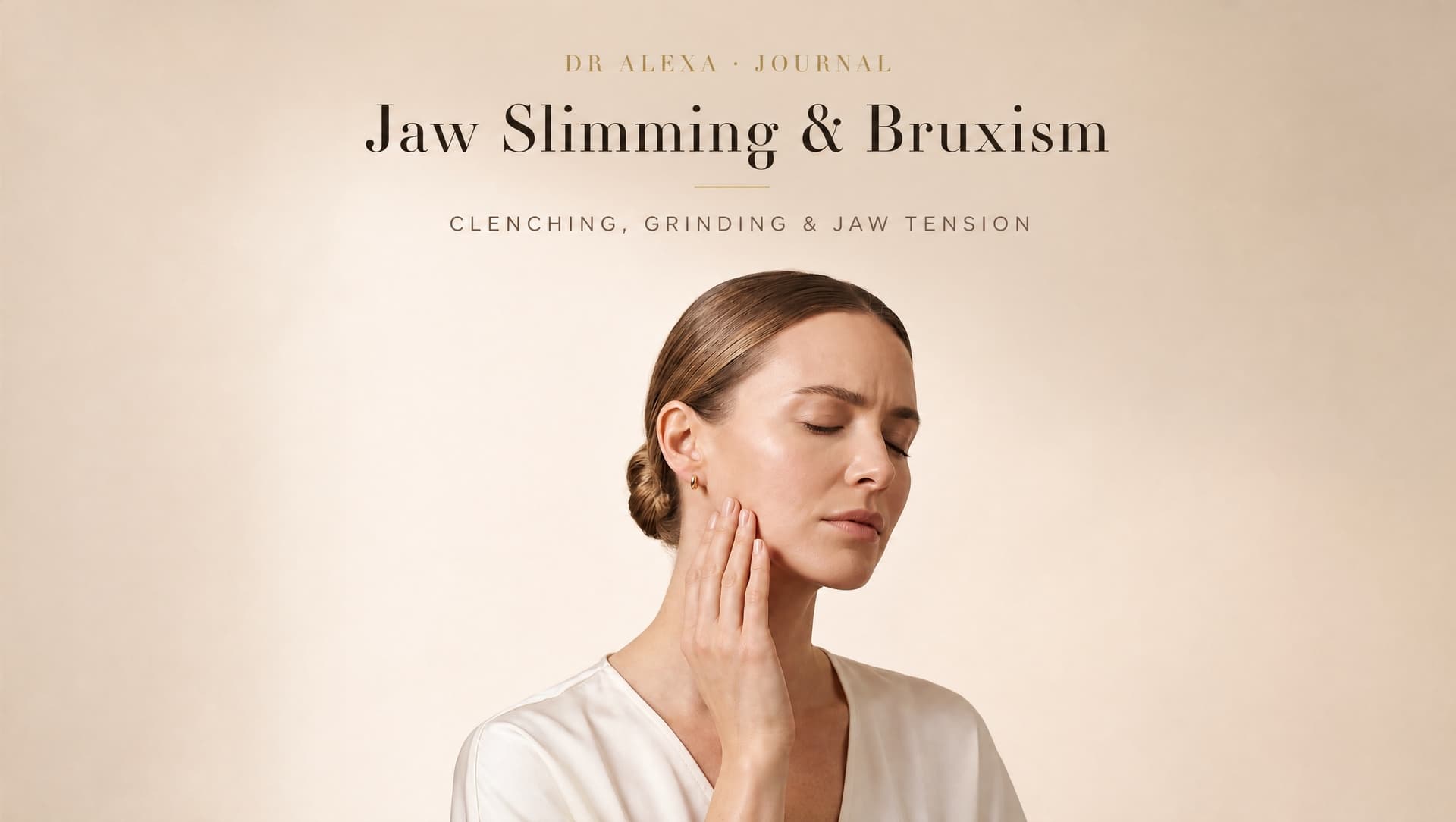
Square jaw, jaw tension or teeth grinding? A dentist-trained, CQC-registered Mayfair clinic explains the causes, your options and what a consultation involves.
Key takeaways
- Your jaw shape isn't only bone. Bulky masseter muscles can make the lower face look wider and squarer.
- Clenching and grinding are common, often happen during sleep, and many people don't realise they do it.
- Signs to look for: morning jaw ache, headaches at the temples, worn or chipped teeth, a clicking jaw, or a partner hearing you grind at night.
- There's no single fix. Good plans often combine approaches, and some options are prescription-only.
- Dental training matters here. Dr Alexa's dental background means your teeth, bite and jaw joint are assessed properly, not just your face shape.
This article is general information, not personal medical or dental advice. Results vary and are not guaranteed.
About Dr Alexa Clinic and who wrote this guide
Dr Alexa Clinic is a doctor-led, CQC-registered aesthetics clinic at 44 South Molton Street, Mayfair (CQC location ID: 1-20415669683). Every treatment is carried out by a medically trained, registered healthcare professional.
This guide was written by Dr Alexa Balan, a GDC-registered dentist (GDC no. 293266) with advanced training in facial anatomy and aesthetic medicine. Her dental training gives her detailed knowledge of the jaw muscles, the bite and the jaw joint (TMJ).
What are the masseter muscles?
You have a masseter on each side of your face, running from the cheekbone down to the angle of the jaw. Clench your teeth and put your fingers just in front of your earlobes, and you'll feel them tighten. They are among the strongest muscles in the body for their size.
Like any muscle, the masseters get bigger with heavy use. Frequent clenching, grinding, chewing gum or very hard foods can enlarge them over time (masseter hypertrophy). The result can be:
- a wider, squarer or more masculine-looking lower face;
- a face that looks heavier at the bottom than at the cheeks;
- jaw muscles that bulge when you clench.
Some people are also simply born with naturally larger masseters or a broad jaw bone.
Clenching and teeth grinding (bruxism)
Bruxism means clenching or grinding the teeth. It can happen while you're awake (often when concentrating or stressed) or during sleep, when it can be very forceful.
Common signs:
| Sign | What you might notice |
|---|---|
| Jaw pain or tiredness | Aching jaw, especially on waking |
| Headaches | Tension-type headaches, often at the temples |
| Tooth wear | Flattened, chipped, cracked or sensitive teeth |
| Jaw joint problems | Clicking, popping, or stiffness when opening wide |
| Muscle bulk | Enlarged, firm jaw muscles |
| Sleep clues | A partner hears grinding at night |
Common contributors: stress and anxiety, poor sleep, caffeine and alcohol, some medications, bite problems, and sleep-related breathing problems such as snoring or sleep apnoea.
What can help?
| Option | What it does | Good to know |
|---|---|---|
| Custom night guard (occlusal splint) | Protects teeth from grinding damage | Made by a dentist; protects teeth but doesn't reduce muscle size |
| Habit and stress changes | Reduce daytime clenching | Notice when you clench and keep "lips together, teeth apart"; limit caffeine, alcohol and gum |
| Physiotherapy, jaw exercises and massage | Ease muscle tension | Helpful for jaw pain and joint symptoms |
| Sleep assessment | Checks for snoring or sleep apnoea | Worth considering if grinding comes with poor sleep or daytime tiredness |
| Prescription muscle-relaxing treatment | Can reduce clenching force and, over time, slim the muscle | Prescription-only; can only be offered after a face-to-face consultation with a qualified prescriber |
| Dental review | Checks your bite, fillings and tooth wear | Important if teeth are already damaged |
For many people the best result comes from a combination, for example protecting the teeth at night while also treating the muscle and the triggers.
Who may not be suitable for treatment?
Some treatments may not be suitable, or may need to be delayed, if you:
- are pregnant or breastfeeding;
- have certain neuromuscular conditions, such as myasthenia gravis;
- take certain medicines, including some antibiotics and blood thinners;
- have an infection in the area;
- have significant jaw joint (TMJ) disease that needs specialist assessment first;
- are under 18. We do not treat anyone under 18.
See your GP or dentist promptly if your jaw pain is severe, follows an injury, comes with swelling or fever, or makes it hard to open your mouth.
What happens at your consultation?
- Your concerns: face shape, pain, headaches, grinding, sleep and your goals.
- Medical and dental history: health, medications, previous treatments and any dental work.
- Assessment: we feel the jaw muscles at rest and when clenched, check jaw movement and the joint, and look at your teeth for signs of wear.
- Photographs for your private medical record.
- A tailored plan: your options, what results to expect, risks, aftercare and costs, with written information to take away. If you need a night guard or dental work, we'll tell you.
- Time to decide. No pressure, ever.
What results can I expect?
When the muscle is the cause, many people notice less jaw tension and fewer headaches within a couple of weeks of treatment. Visible slimming of the lower face is gradual, usually developing over several weeks, and gives a softer, more tapered face shape. Results are temporary and need maintenance. We'll explain realistic timelines for your plan at consultation.
Frequently asked questions
Can a square jaw be slimmed without surgery?
Often, yes, when the width is caused by large jaw muscles rather than bone. A consultation will show which it is.
How do I know if I grind my teeth?
Common clues are a sore jaw or headache on waking, worn or chipped teeth, a clicking jaw, or a partner hearing grinding at night. A dental examination can confirm it.
Will a night guard stop grinding?
A night guard protects your teeth from damage, but it usually doesn't stop the grinding itself or reduce muscle size. It's often combined with other approaches.
Is jaw slimming only cosmetic?
Not always. For many people, the main benefit is relief from clenching, jaw ache and tension headaches. A slimmer face shape follows as the muscle relaxes.
Does teeth grinding cause headaches?
It can. Clenching overworks the jaw and temple muscles, which can cause tension-type headaches, often first thing in the morning.
Why see a dentist-trained clinician for jaw concerns?
Clenching and grinding affect the teeth, bite and jaw joint as well as face shape. A dentist-trained clinician can assess all of these together and spot problems that need dental care.
Where can I get a jaw slimming or teeth grinding consultation in Mayfair?
At Dr Alexa Clinic, 44 South Molton Street, Mayfair, London W1K 5RT, a doctor-led, CQC-registered clinic a few minutes' walk from Bond Street station. Call 020 7846 6403.
Related Treatments
Book your consultation
If your jaw feels tense, you're grinding your teeth or you'd like a softer lower face shape, start with a face-to-face consultation. We'll find the cause and explain every suitable option before you decide anything.
Dr Alexa Clinic, 44 South Molton Street, Mayfair, London W1K 5RT. CQC-registered (location ID 1-20415669683). Dr Alexa Balan is a GDC-registered dentist (GDC no. 293266). All treatments are subject to consultation and suitability. Results vary and are not guaranteed. For adults aged 18 and over only.